A Small Object Display That Leaves Room to Look
A small object display can give meaningful pieces room to register. Use one focal point, deliberate gaps, and a few simple adjustments to keep it quiet.
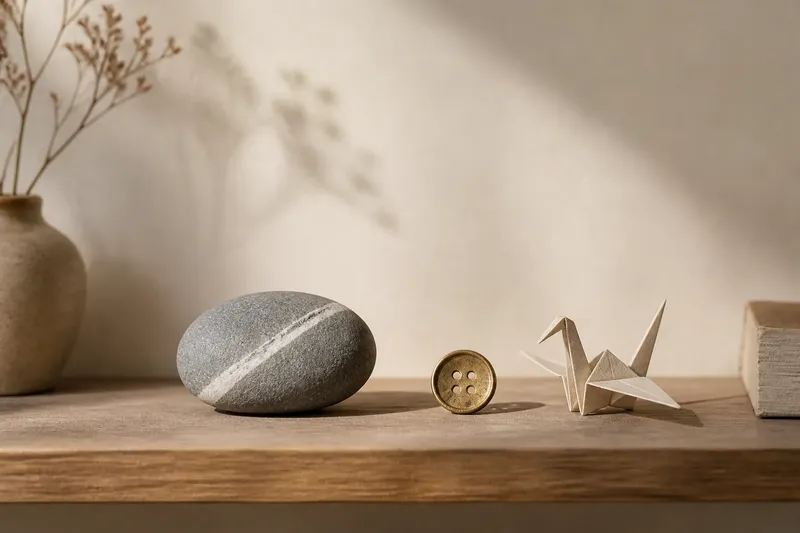
On a quiet afternoon, a shallow shelf catches the light while a brass button, a folded paper bird, and a smooth stone wait in a row. A small object display does not need matching pieces to feel considered; it needs enough space for each object to be seen as itself.
The useful question is not what belongs together, but what deserves attention first. A deliberate focal point gives the eye somewhere to land, while open space keeps the other objects from becoming a single, busy shape.
What should the eye notice first?
Choose one object to carry the display. It might have a strong silhouette, an unusual surface, or a personal association that makes you pause. The focal point does not have to be the largest piece; a modest object can lead if its shape or placement gives it visual weight.
Set it slightly off center rather than automatically placing it in the middle. A centered arrangement can look formal, which may suit a mantel or a carefully balanced niche. For a looser arrangement, try a position nearer one end and let the surrounding objects answer it without competing.
Keep the supporting pieces quieter in placement, not necessarily in meaning. A pale shell beside a dark carved bead may create contrast without either being promoted to equal status. If every piece is equally prominent, the eye has to do the curatorial work you meant to do.
Choose the lead object before arranging the rest.
How much space lets each piece breathe?
Spacing is not a fixed formula. A thin paper object needs a different margin from a bulky ceramic one, and a tight grouping may feel intimate where a broad gap would feel like an accident. Start with generous space, then bring pieces closer only when their relationship becomes clearer.
Look at the negative space as carefully as the objects. The gaps between pieces form shapes of their own: a narrow wedge, a broad pause, a clear strip of shelf. If those shapes all feel pinched or uniform, move one object rather than adding another to fill the emptiness.
Physical clearance matters too. A dangling thread, a fragile paper edge, or a stone that rolls should not be crowded against a neighboring piece. Leave enough room to lift an object without knocking its companions, especially if you dust the shelf regularly.
When uncertain, remove a piece and see whether the remaining arrangement becomes easier to read.
Which surface and background help the objects speak?
A display surface contributes its own color, texture, and history. A matte wooden shelf can soften the hard shine of metal; a plain tray can give small, irregular pieces a visual boundary. A patterned cloth may be part of the meaning, but it can also compete with delicate shapes.
Try a background that differs gently from the objects rather than matching them. A dark bead can disappear on dark wood, while a white shell may lose its outline against a pale wall. Contrast does not need to be dramatic; a slight change in tone or texture can make edges easier to follow.
Consider the view from the place where you usually sit or pass. A display seen at eye level behaves differently from one viewed from above on a low table. Turn the objects toward that ordinary sightline, and avoid arranging them only for a photograph taken straight on.
Use a removable mat or a small board if the shelf itself is visually noisy.
How can the objects relate without becoming a set?
Let one connection do the work: a shared material, a contrast in shape, or a difference in scale. The objects need not tell a complete story, and they need not come from the same place. Their arrangement can suggest a relation while leaving the interpretation open.
Say you have a chipped blue tile, a brass key with no known lock, and a paper tag saved from a parcel. Place the tile as the focal point, angle the key toward it, and leave the tag a little apart. The expected result is a display in which color and direction connect the pieces, while the gap keeps the tag from looking like part of a manufactured trio.
Avoid repeating the same spacing and alignment for every object. A small change in angle can make a grouping feel observed rather than assembled from a shop display. Keep that change modest; an object placed at a dramatic angle may start to look as if it is trying to escape.
Arrange for a relationship, not a coordinated collection.
What should you check before leaving it in place?
- Focal point: Can you identify the first object your eye reaches? If not, shift one piece forward or remove a competing one.
- Silhouette: Do neighboring outlines merge? If they do, widen the gap or change the angle.
- Background: Can you follow each edge against the surface? If an object disappears, try a different backing.
- Clearance: Can you pick up each piece without brushing the rest? If not, spread the arrangement or use a tray with more room.
- Viewing angle: Does the display still make sense from where you pass or sit? If not, turn the focal object toward that view.
- Light: Does glare hide a mark or surface detail? If it does, adjust the display's position rather than adding more objects.
These checks are most useful after stepping away briefly. Returning with fresh eyes can make a crowded corner or an overlarge gap easier to notice.
What changes when the display is moved?
Daylight shifts across a room, and a shelf near a window may look calm in the morning and reflective later. Notice whether metal throws glare or whether a translucent piece loses its color against bright light. A position that works from one angle may flatten the objects from another.
Dusting and handling are part of the display, not interruptions to it. Leave the most frequently handled object within easy reach, and avoid placing delicate material where sleeves or bags brush past. Follow any care instructions supplied with an object or material, and check local requirements where they apply.
For an afternoon arrangement, temporary supports can help you test positions without committing to them. A folded piece of neutral card or a shallow dish can lift a small object into view, provided it is stable and does not obscure the object itself. Remove the support if it begins to attract more attention than the piece.
What questions come up when arranging a few objects?
How many objects belong in a small display?
There is no useful fixed number. Stop when the focal object and its companions can each be distinguished without crowding the available surface.
Should the focal object sit in the center?
It can, especially when symmetry suits the setting, but an off-center position often gives a small arrangement more ease. Let the object's visual weight and the available space guide the choice.
Can objects with different materials sit together?
Yes, if their contact is safe and their contrast helps the arrangement. Keep fragile finishes from rubbing against harder edges, and use a barrier when the materials or care instructions call for one.
How often should a display change?
Change it when the arrangement stops holding your attention or no longer suits the surface and light. There is no need to rotate objects on a schedule; a quiet display is allowed to stay quiet.
When does the arrangement feel finished?
It feels finished when the focal object is clear, the supporting pieces have room, and the empty areas look intentional rather than forgotten. The arrangement need not explain why the objects matter. Their placement can offer a small invitation to look, then leave the rest to the person standing there.
A small object display works best when it remains easy to revise. Keep the pieces accessible, and let a change in light, season, or attention suggest the next arrangement. Empty shelf space is not a flaw to correct; sometimes it is what lets a meaningful object make its quiet point.