Before the Pattern: How Printed Paper Entered the Home
Printed decorative paper moved through walls, drawers, boxes, and parcels, showing how households used pattern to shape rooms and give ordinary objects a personal finish.
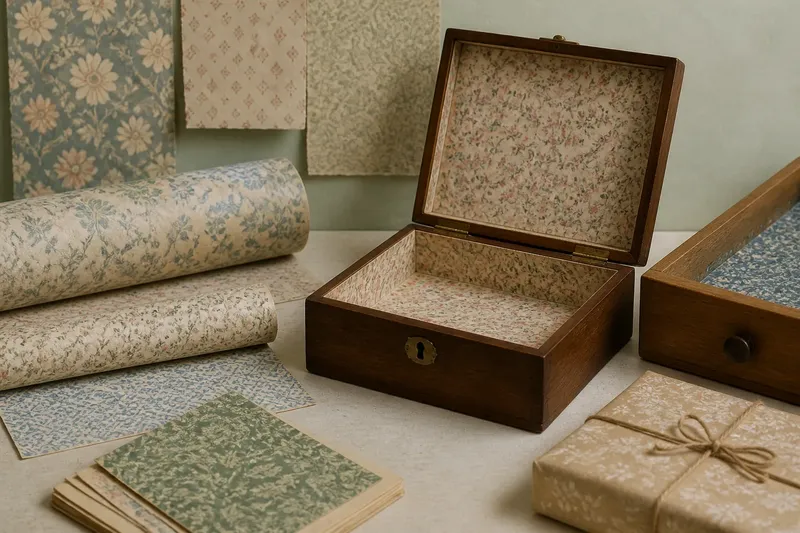
A patterned sheet tucked inside a wooden box can go unnoticed until the lid opens. Printed decorative paper entered the home in such ordinary ways: as a surface to cover, protect, wrap, or personalize. Its history is best read through those uses, rather than as a single invention with one route into domestic life.
How did printed paper reach household interiors?
There was no single route or timetable. In different places and periods, paper reached households through local makers, merchants, and shops; the particular designs and methods of sale varied with local conditions. Without a specific place and period, it is more accurate to describe these as possibilities than as a universal trade history.
Printed patterns could echo the look of woven cloth, tile, or other decorated surfaces. That resemblance offered a visual effect, not a material substitute: paper did not acquire the wear or feel of the surface it depicted. A sheet might also be bought for one purpose and later reused for another.
Availability and meaning depended on the household and its surroundings. In one setting a patterned sheet might be a carefully chosen furnishing; in another, a useful remnant for a drawer or box. The object alone cannot tell us how common, costly, or valued it was.
Why put printed paper on a wall?
A wall covering made a pattern part of the room, visible to everyone who entered. It could give a plain surface visual order or draw attention to a particular wall, recess, or fireplace area. A household could choose to cover one part of a room rather than treat every wall alike.
Paper also offered a way to change the look of a surface without changing the room’s furnishings. Its suitability depended on the wall and the paper: damp, smoke, roughness, and wear could all matter. For a present-day project, follow the paper maker’s instructions and check that the material is appropriate for the surface.
For a room with changing uses, a smaller papered area can be easier to revise than a full-room scheme.
What did paper do beyond decorating walls?
Printed paper could line a drawer, cover a box, protect a shelf, or wrap a parcel. These uses brought pattern close to daily handling, sometimes in places visitors would not see. A lining could be chosen for the person opening the drawer, not for an audience.
Paper’s value did not depend on lasting indefinitely. A sheet could make a container feel more finished, then be replaced if it became marked or torn. In that role, decoration and upkeep were not opposites; the same material could serve both.
How did household habits shape the use of printed paper?
People could compare samples or patterns before choosing paper for a room or object, where such materials were available. A sample placed beside a curtain, painted surface, or piece of furniture could help a buyer judge color and scale in context. The specific ways designs were produced, sold, and selected differed by place and period.
Maintenance shaped the decision too. Paper could refresh a surface, but it could also show marks or deteriorate. A household had to weigh the appearance it wanted against the care that surface would need.
When does printed paper feel personal rather than public?
Placement makes a difference. A pattern across a shared room is visible to visitors; a strip inside a cabinet or lining in a desk drawer may be encountered mainly by its owner. Motifs also take their meaning from context: a floral repeat might suggest a garden, a season, or simply an appealing arrangement of shapes.
Say a household has a plain wooden writing box and a leftover sheet of floral paper. They cut a piece to fit the inside of the lid and secure it with an adhesive suitable for the box’s surface; when the lid opens, the exterior remains plain while the interior shows the chosen pattern. The tradeoff is that the lining adds a personal detail but may wear sooner than the wooden exterior.
Which printed paper fits a household use?
Can wallpaper line a drawer?
It can work if its thickness and finish suit the drawer and the maker’s directions allow the intended use. Set a sample against the drawer’s base and edges; if it bunches or catches, choose thinner paper or leave the drawer unlined.
How is decorative paper different from wrapping paper?
Decorative paper is a broad description of paper used to add pattern, while wrapping paper is intended for covering a parcel or gift. If the sheet will be handled or folded often, check its weight and coating; if it creases poorly or scuffs easily, choose a paper made for wrapping.
Does a small pattern always make a room feel larger?
No. Light, contrast, repeat, furnishings, and the amount of covered wall all affect how a pattern reads. If a sample looks busy beside the room’s existing surfaces, try a quieter pattern or use it on a smaller area.
How should old printed paper be kept?
Light, damp, and handling can harm paper. Keep an ordinary fragment dry and out of direct sunlight; if a piece is fragile or valuable, ask a paper conservator before cleaning, flattening, or repairing it.
What can printed paper tell us about keeping?
Paper often worked alongside objects a household already owned. A lining could make a worn box more pleasant to use, or a new covering could alter a room without replacing its furnishings. That does not mean every household used paper this way; the surviving object and its setting matter.
The useful question is not only what pattern appears on the sheet, but what it covers and how someone encounters it. A wall covering faces a room; a drawer lining meets a hand; a parcel wrapper marks something as set apart. Those positions give the same material different meanings.
When looking at printed paper in a home, note its placement, condition, and relation to the object beneath it. Those details can reveal more about its everyday purpose than the pattern alone.