Clay, Wood or Paper: Choosing a Material for a Small Keepsake
Clay, wood or paper for a small keepsake? Compare their feel, working qualities and visual character to choose a material that suits the memory.
You find a ticket stub in a coat pocket, a leaf pressed inside a book, or a note folded small enough to have outlasted its envelope. Choosing a material for a small keepsake begins with the part of that find you want to carry forward: its texture, its shape, or the marks it already holds. Clay, wood and paper each make a different kind of record.
For a modest, non-load-bearing object, the choice is less about which material is best than about what kind of attention you want the object to invite. Clay can make a memory tactile and compact; wood lends it grain, warmth and a sense of handling; paper preserves fine marks and folds with little alteration. Consider how each feels to work, what it asks of the maker, and what its finished surface will say.
What should a keepsake material do?
Start with the memory rather than the craft supply. Is the important part a word, a silhouette, a rough surface, or the fact that something was carried from one place to another? A material can echo that quality, or deliberately give it a new form.
Then ask how you expect to encounter the finished object. A keepsake meant to be picked up can benefit from a solid, tactile body. One meant to be slipped into a book or drawer may be more comfortable as a thin sheet. If you want to notice an existing mark without rebuilding it, paper may preserve more of the original character than a newly shaped object.
Scale matters in a practical, not numerical, sense. A small object gives the hand limited room to correct a cut, smooth an edge or adjust a line. Choose a material whose working qualities suit the marks you want to make at that scale.
What does clay make possible?
Clay is the most direct choice when touch belongs in the keepsake. Even a simple pressed form can retain the pressure of fingers, the soft edge of a tool, or the outline of a small object. Its visual character is often quiet and bodily: rounded, matte, earthy, and unmistakably made by hand.
That closeness comes with a particular working rhythm. Soft clay invites pressing, pinching and smoothing, but it can also take an unwanted fingerprint or lose a crisp edge while being handled. If you want a neat outline, it helps to decide which marks are intentional before the surface begins collecting the rest.
Clay suits someone who wants an object to feel like an impression rather than a document. It can translate a leaf vein, a cloth texture or a handwritten mark into relief, though the result is a new interpretation, not a perfect copy. Fine lettering can be difficult on a small surface, especially when the mark needs to remain legible after shaping.
There is also a finishing decision. Air-dry clay and other clays do not all behave alike, and their recommended handling and finishing depend on the product. Follow the maker’s instructions for the clay and any finish you choose, and consider whether the finished object will be handled often or mostly kept still.
Choose clay when the memory has a tactile quality you want to preserve, and when a slight irregularity feels like part of the point.
Why choose wood for a keepsake?
Wood gives a small keepsake a visible history before you add anything to it. Grain, knots and changes in tone make every piece look particular, while a smooth edge can make it pleasant to turn in the hand. The material reads as warm and steady, even when the object itself is modest.
Its working qualities depend on the piece. A prepared wooden blank may be easy to mark with pencil, paint or a suitable pen; rougher or more porous wood can absorb marks unevenly. Grain can interrupt a fine line, which may be charming for a loose drawing and inconvenient for small, precise lettering.
Wood is a good fit when the keepsake should seem made to stay. It can hold a simple symbol, a short inscription or a contour without looking like a page removed from a notebook. Yet it asks the maker to work with the surface rather than treat it as neutral: a mark that crosses grain will look different from one that follows it.
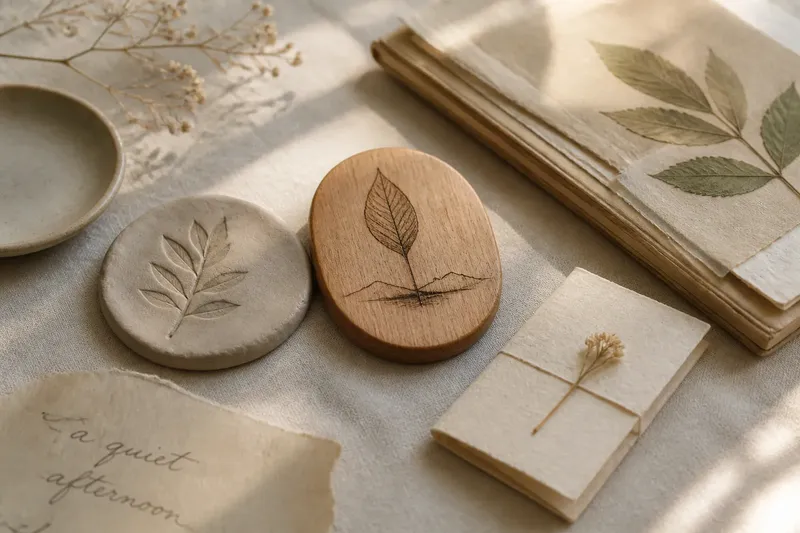
Say you want to remember a quiet afternoon spent drawing leaves with a friend. Imagine choosing a small, smooth wooden blank, then adding one leaf outline and the place name in pencil or paint; the expected result is a compact object whose grain remains visible around the drawing, making the material part of the memory instead of mere backing. If the words are the main thing, a paper keepsake may give them more room to breathe.
Wood suits someone who wants a durable-feeling, hand-held object with natural variation, and who does not mind letting the grain participate in the design.
When is paper the better choice?
Paper is often best when the original evidence is already a mark: handwriting, a ticket, a map fragment, a drawing or a pressed plant. It accepts fine lines and small details without asking you to turn them into relief or transfer them onto a new surface. Its visual character can be crisp, layered, folded or visibly worn.
Unlike clay or wood, paper makes its structure part of the object. A crease can indicate that something was carried; a torn edge can preserve how it was found. You can cut, fold, layer or stitch paper, but each action changes the record. A clean new sheet gives a different feeling from an envelope with a rubbed corner.
Paper suits a reader who values language, delicate detail or the evidence of use. It is also easy to keep flat and to place among letters or books. Its lightness, however, may make it feel more like a document than a keepsake object, so consider whether that is welcome or whether you want a heavier material to lend the memory a more physical presence.
There is no need to make paper look precious. A small fold, a handwritten date, or a careful mounting can be enough. If the source is fragile or has sentimental importance, avoid altering it casually; a separate paper copy can carry the design while the original remains as it is.
Which material suits which kind of memory?
Clay, wood and paper do not simply offer different looks. They suggest different relationships to the thing remembered: clay makes an impression, wood gives a mark a home, and paper keeps a trace close to its original form. The comparison below can help make the decision concrete.
- Choose clay if touch, pressure or a three-dimensional shape matters most. It suits a maker who welcomes soft edges and hand marks.
- Choose wood if you want a compact object with grain and a settled, hand-held feel. It suits a simple image or short inscription that can share space with the material.
- Choose paper if words, fine lines, folds or existing marks are central. It suits a keepsake that can live among notes, books or other flat objects.
- Choose a new copy rather than the original if the source is fragile and you want to experiment. The copy can carry the design without making the source absorb every craft decision.
Try describing the keepsake without naming its material. “A rough impression of a shell” points toward clay; “a leaf mark against grain” points toward wood; “the note as it was folded in a pocket” points toward paper. The words often reveal whether you care most about touch, material presence or faithful detail.
How do you compare the materials before choosing?
A short, low-stakes trial can clarify a choice without requiring a finished design. Use spare material, make the same simple mark on each surface, and notice what the hand does: presses, guides or writes. Keep the trial small enough that you are comparing working qualities, not judging a polished object.
Which material keeps a handwritten note legible?
Paper is usually the most direct fit for a note because it accepts ordinary writing without translation. Wood can hold a brief inscription, but grain and surface texture may affect the line; clay can carry lettering too, though shaping and scale can make fine words less easy to read.
Which material makes the strongest tactile impression?
Clay is the most naturally suited to a pressed texture or shallow relief. Wood offers tactile grain and softened edges, while paper can make touch matter through folds, layers and surface texture rather than depth.
Which material is easiest to alter while working?
Paper is generally easy to trim, rearrange and replace, while soft clay can be reshaped before it is finished. Wood is less forgiving of a mark that needs moving, so a light pencil layout can help when the placement matters.
Can the original object be used as the keepsake?
Sometimes, but not every source benefits from being cut, pressed or mounted. If it is fragile, meaningful or hard to replace, make a copy or a drawing and keep the original intact; the keepsake can preserve the memory without making the source do craft duty.
How can a small keepsake feel deliberate?
Give the material one clear job. A clay piece can preserve a texture; a wooden one can frame a small mark; a paper one can retain a phrase or a fold. When a keepsake tries to include every detail of a memory, its small surface can become crowded.
Leave some material visible. A thumbprint in clay, a band of grain on wood or an unmarked margin on paper can give the eye a place to rest and remind you what the object is made from. Decoration is not the only way to show care; sometimes restraint makes the choice easier to read.
Keep the making process suited to the material rather than forcing a favorite technique onto all three. A fine pen may feel natural on paper but awkward on rough wood; carving may suit wood but change the surface more than the memory requires. The right tool is the one that lets the chosen material do its own quiet work.
Choosing clay, wood or paper for a small keepsake comes down to the kind of evidence you want it to hold. Reach for clay when a memory should be felt, wood when it should sit within a living grain, and paper when its words or marks deserve to remain close. The useful choice is the one you will recognize in your hand or on the page without needing to explain it.