The Myth That Every Collection Needs a Theme
The myth that every collection needs a theme can make keeping feel like homework. Describe your objects through their stories, habits, and connections instead.
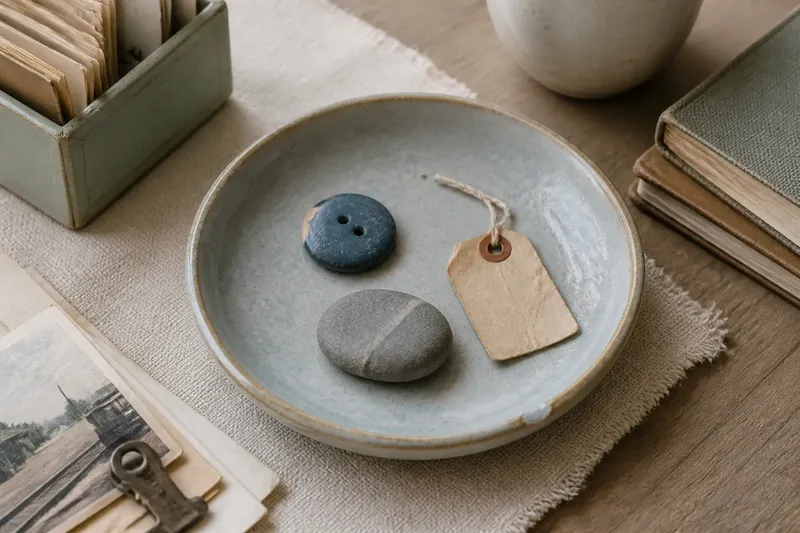
A chipped blue button sits in a saucer beside a smooth stone from a train platform and a paper tag from a coat long gone. The myth that every collection needs a theme says these objects do not belong together. The saucer disagrees, though it is not much for arguments.
A collection can be orderly, but order is only one way to make it legible. Personal collecting may follow a formal category, such as matchbooks or studio pottery, or it may gather around less visible ties: a habit of picking things up, a person who gave them, or the places where they have waited. You do not need to turn those ties into a rule before they count.
What does a collection need besides a theme?
It needs some relation among its things, but that relation does not have to be obvious to a visitor or consistent across every object. A set of postcards may connect through their paper, their destinations, their senders, or the drawer in which they were kept. Those explanations can overlap without competing for authority.
Try describing what you notice before deciding what the collection is. Perhaps you keep small things that have passed through other people’s hands, objects with useful marks, or items that were never meant to be saved. These are observations, not admission requirements. An object does not have to qualify for the collection before you are allowed to care about it.
For a first description, name the objects plainly, then add the connection that feels most alive today. “Buttons, stones, and paper scraps I brought home from ordinary errands” is accurate enough to begin with. It leaves room for the collection to change without making the earlier description false.
How can you describe a collection without imposing a rule?
Use a sentence that reports a practice rather than defining a boundary. “I tend to save…” and “These remind me of…” describe what happens. By contrast, “I collect only…” can sound like a policy drafted by a very small committee, especially when your next favorite object arrives outside its jurisdiction.
Keep the description provisional. You might call the objects “things from places I have waited” even if one came from a friend’s kitchen and another from a bus stop. The phrase points toward a shared feeling, not a test that each object must pass.
Imagine you have a jar of ticket stubs, a brass key with no known lock, and a fabric label removed from a sweater. You could describe them as “small records of things I passed through or let go,” then add a new object when it earns a place by feeling related. The observable result is a description that helps you recall why the objects matter without requiring the key to become a ticket.
How can a week of noticing change the description?
A short routine can help when a collection feels scattered, or when a neat label has started to feel like an assignment. Set aside a week to notice what draws your attention. Do not sort, buy, discard, or rename anything during this period; the point is to observe your habits before imposing an explanation.
- On the first day, choose a small group of objects already together, such as a shelf of found items or a tin of saved paper. Write down what is there in ordinary terms.
- On the second day, note where each object came from, if you know. Mark uncertainty plainly; “unknown” is a useful description, not a failure of recordkeeping.
- On the third day, notice what you touch, move, or look at again. Record the action rather than trying to assign a symbolic meaning.
- On the fourth day, ask what the objects share besides appearance. Possible links include a giver, a route, a household task, or the reason you kept them.
- On the fifth day, write two possible descriptions. One can name a material or category; the other can name a habit, memory, or recurring circumstance.
- On the sixth day, read both descriptions beside the objects. Keep the one that helps you talk about them without making an awkward exception list.
- On the seventh day, leave the objects as they are and decide whether the description is useful enough to keep. If not, let it remain a note from the week rather than a permanent title.
The routine is for noticing, not for producing a final identity. A collection may have several descriptions, each useful in a different setting. One can help you remember where things came from; another can explain why they stay together in a drawer.
What do people ask about collections without themes?
Can unrelated objects still be a collection?
Yes. A collection can be held together by a person’s attention, memory, or repeated habit rather than by matching forms. If you can say why you keep returning to the objects, that relation may be enough for your purposes.
Should I sort a collection by color or material?
Sort by color or material if it helps you find, handle, or enjoy the objects. It is an arrangement choice, not proof that the collection must be uniform. You can change the arrangement without changing what the objects mean to you.
What if my collection keeps changing?
Let its description change too. A phrase that fit when you kept only paper ephemera may need room for a tool, a fragment of cloth, or an object someone gave you. Updating the words is more honest than excluding an item just to protect an old label.
How do I explain my collection to someone else?
Start with one concrete object and tell the short reason it stayed. Then mention the wider connection, if there is one. A conversational description can be partial; it does not need to function as a museum catalogue or a defense of your shelf.
When is a theme still useful?
A theme can make a collection easier to store, study, lend, or share. If you gather ceramic vessels by a particular maker, a clear category may help you keep notes and recognize gaps in what you know. That practical value is real, but it does not make thematic collecting the superior form of keeping.
Use a category when it serves a decision you actually face. You might group objects by material because they need different storage, or by source because you want to remember who gave them. When the category stops helping, it can become one description among several rather than a rule that polices the collection.
For collections with sentimental or family significance, a brief note can preserve context that an arrangement cannot. Write down a name, place, or reason for keeping an object where you can find it later. If you do not know the full story, leave the gap visible instead of filling it with a tidy guess.
What should you do with the description now?
Choose words that make it easier to care for the objects, not words that make them behave. The myth that every collection needs a theme can be useful to question whenever you are tempted to remove a beloved outlier merely to keep a sentence neat.
Put the description somewhere modest: on a note in the drawer, in a small notebook, or in a message to the person who asks about the objects. Let it be a working account of your attention. Collections do not always explain themselves, and yours need not be better organized than the reasons you keep it.